Thursday, 14 January 2016

BMW M2: Back to Basics


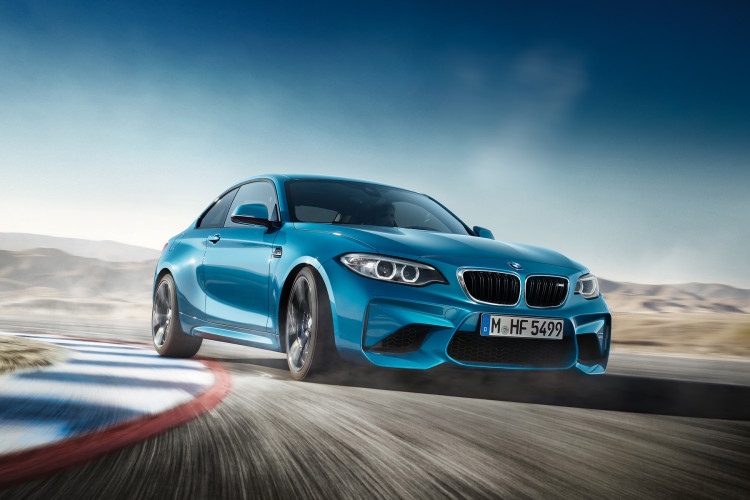
As the M range moves higher up in price, the M2 puts its performance back in reach of mere mortals. Under the hood is a 3.0-liter turbo inline-six that makes 365 hp and 343 lb-ft. A six-speed manual and rear-wheel drive are standard; a seven-speed dual-clutch automatic is optional. Weight is reduced wherever possible, including 19-inch forged wheels shod with specially designed Michelin Pilot Super Sport tires. Beefy brakes aid stopping; BMW says 60 mph comes in 4.2 seconds with the automatic.


There's a lot to love. The M3, BMW's legendary compact performance car, got bigger and bigger over the years, leaving room for a new model that captured the spirit of the original. The modern M3 and M4 — both more than 3,500 pounds — have strayed miles from the E30 M3 of the late ’80s, a revered model that tipped the scales at under 3,000.


But it's not just that the M2 is the spiritual successor to one of the best cars BMW ever made. There are also the numbers: this car will sprint from 0-60 as quickly as a $100,000 M5, if BMW's own specs are to be believed. (And BMW has a tendency to underrate, which suggests the M2 could have a 0-60 time under 4 seconds.) Power is provided courtesy of a turbocharged inline six good for 365 hp. And you can get it with an honest-to-goodness manual transmission, a rarity among modern performance cars.


And then there's the appearance. This car looks great in person, wide enough at the rear to look downright musclebound. It's impossible to mistake it for a garden-variety 2, which is good news for the few who get to buy one. List is $51,700, but the M2 is a limited-run car — and if the predecessor 1 M is any indication, these will sell out quickly and be worth more than sticker when they launch later this year.


The turbocharged N55 inline-six engine has been extensively tweaked to produce 365 horsepower at 6500 rpm. Maximum baseline torque is 343 lb-ft, available from 1400 to 5560 rpm, while an overboost function serves up 369 lb-ft from 1450 to 4750 rpm. Fitted with a single turbocharger, the engine redlines at 7000 rpm. By comparison, the M235i cranks out a maximum of 320 horsepower and 330 lb-ft of torque. Besides the six-speed manual, there is an available seven-speed dual-clutch automatic—as opposed to the M235i, which offers an optional eight-speed torque-converter automatic. The cooling system is heavily modified to help the M2 deal with a track environment, and the dual-clutch gearbox gets its own oil cooler. The sprint to 60 mph is said to take 4.2 seconds with the automatic and 4.4 seconds with the manual; we achieved zero-to-60 times of 4.3 and 4.9 seconds from the automatic and manual M235i. Top speed is governed at 155 mph.


But the M2 is as much about cornering dynamics as it is about straight-line performance, and BMW has cut no corners with the M2. Under the taut sheetmetal of the 2-series, the company’s engineers have essentially packed the chassis of the M3. Compared to the M235i, the front track increases from 59.9 to 62.2 inches and the rear track from 61.3 to 63.0. With its larger fenders, the car itself is now 73.0 inches wide, up from 69.8 inches. Combined with a slightly lower height (55.5 instead of 55.8 inches), the M2 looks muscular and powerful.


The M2 is fitted with 245/35ZR-19 front and 265/35ZR-19 rear tires; an electronic rear differential (Active M Differential) will help you keep the car in an easily controllable drift. And the transmissions are programmed to play along: The manual transmission includes a rev-matching function for downshifts, while the DCT has what BMW actually calls a "smoky burnout function."


The aggressive styling of the M2 sharply differentiates it from the M235i; it features a unique front end, large air intakes, a rear spoiler, and four exhaust pipes that are as loud as they are impressive to look at.


Wednesday, 13 January 2016

Ford Fusion V6


Ford has showcased the Fusion V6 Sport, a high-performance version of the stock car, at the 2016 North American International Auto Show (NAIAS). The new Ford Fusion V6 Sport comes with an all-wheel drivetrain powered by a twin-turbocharged V6 engine. Ford proudly proclaims that the Fusion V6 Sport will, “leave other family sedans — including the Honda Accord and the Toyota Camry — in the dust.” Ford also says that the Fusion V6 Sport out-powers the 2016 BMW 340.

The Ford Fusion V6 Sport gets a 2.7-litre EcoBoost motor that makes 325PS and 475Nm of torque. These numbers are far more than that of the Toyota Camry and Honda Accord. The real-time suspension tuning system adjusts the damping levels according to the condition of the road. This system detects potholes and accordingly adjusts the shock absorbers to reduce the impact transmitted to the cabin.

The design of the Ford Fusion V6 Sport complements its performance with an aggressive exterior. The air intakes have a larger and deeper area and are finished with a gloss black-finish mesh grille. It also gets neat 19-inch wheels to go with the package. The rear profile of the new Ford Fusion V6 Sport features a sleek looking spoiler and dual exhaust outlets.

The Ford Fusion V6 Sport also happens to be the first car from Ford in North America to feature a pedestrian detection system. It also features hands-free parallel and perpendicular parking and Sync 3. In addition to the Fusion V6 Sport, Ford also showcased the Fusion Hybrid, Fusion Energi, and Fusion Platinum at the 2016 Detroit Motor Show.

“Fusion offers people a lot more in the car – including helpful technology, beautiful design and a more rewarding driving experience compared to other midsize sedans,” said Raj Nair, Ford’s executive vice president and chief technical officer of Global Product Development.

Tuesday, 12 January 2016

Bentley Bentayga SUV


Legend has it that Ettore Bugatti once called the Bentley 4½ Litre the “world’s fastest truck.” We’re guessing that he didn’t know he was merely being prophetic. Because now Bentley builds an SUV, and guess what? Its 187-mph top speed is the highest on record for a vehicle of that type.


Why an SUV? Simple: People who drive Bentleys tend to have other vehicles (a lot of them), and the vehicle they drive in the winter—or when it’s raining, or foggy, or below 75 degrees—tends to be an SUV. Now that Bentley makes an SUV, a lot of those buyers will make that SUV a Bentley, as well.


For the last three years, Bentley has sold more than 10,000 vehicles annually, a major milestone for the company. The Bentayga is going to help obliterate that record: The company plans to build 5500 Bentaygas in 2016. That estimate already has been revised upward once, and company executives tell us that, as interest builds, that figure may enjoy yet another upward correction.


The Bentayga will join Bentley's line comprising of the fast Continenetal GT, sublime Flying Spur and the majestic Mulsanne.

And while the Bentayga might be tall for a Bentley at 68.6 inches, it’s not otherwise particularly large for one. At 202.4 inches long and 78.7 inches wide, it’s about 17 inches shorter than a Mulsanne and three inches wider. At nearly 5400 pounds, it’s about 550 pounds lighter than the Mulsanne and just shy of a Flying Spur W-12. The floorpan is steel, but most of the rest of the sheetmetal is aluminum, including all exterior panels. Bentley says that the body side is the auto industry’s largest single aluminum stamping.


With its (relatively) low mass for a Bentley, the Bentayga is kind of spectacular to drive. The damping of the multilink front and rear suspensions is exemplary. Even over the extreme speed bumps peppered throughout the hamlets of southern Spain, the most massive of wheel displacements are forgotten in a single, gentle compression and rebound of the suspension. The electric power steering is weighty and direct, although it doesn’t enjoy a ton of feel. But by SUV standards, it’s excellent. As are the brakes. The pedal is firm and progressive, and even barreling down the twisting switchbacks of the Sierra Blanca mountains, there was never a hint of fade.


Handling is neutral enough that you’ll forget this is a 5400-pound SUV with a 12-cylinder engine in the nose. Sure, you can force it into understeer, but you can also set it up to flow through turns better than a vehicle this size has any right to, mostly because it corners remarkably flat. Its outstanding body control is the result of Bentley Dynamic Ride, a new active anti-roll bar that counteracts natural roll with a pair of electric actuators, one at each end of the vehicle to stiffen and soften the front and rear bars. It’s a trick system, but don’t expect the sports-car world to rush to adopt it. In order for the system to act quickly enough, says product-line director Peter Guest, it needs to operate on 48 volts, with a supercapacitor meting the voltage. With the bars, the actuators, the supercapacitor, and the heavy-duty cables—which he says are about four times the diameter of most automotive cables—the system weighs between 30 and 40 pounds. Bentley chief executive Wolfgang Dürheimer says Bentley Dynamic Ride is technically capable of leaning the Bentayga into a turn, motorcycle-style, but, in the interest of passenger comfort, the company stopped short of allowing that capability. We’d be quite interested to see what sort of impact that would have on cornering. The system allows a firm, controlled—but never harsh—ride on pavement but allows maximum wheel articulation off.


Ready to Crawl
That’s right: off road. Because this is a Bentley meant for dirt, our drive included some semi-serious off-roading. At first we feared that the trail was going to be too easy, something a rental Toyota Camry could conquer, but we got into some pretty tricky attitudes—the oiling system is designed to keep the engine lubricated at up to 35 degrees of tilt in any direction. We crawled through a few ditches that had the Bentayga alternately kissing the ground—a few trucks in our group actually did scuff their chins, an occurrence that is probably about 10 times more expensive than your entire beater Jeep—and hanging a rear wheel off the ground at full suspension droop.

There are, of course, additional vehicle settings for off-roading: snow and grass, dirt and gravel, mud and trail, and sand dunes. There are two suspension settings that raise ground clearance a little or a little more (Bentley declined to provide specific figures). Hill-descent control holds your speed on downslopes, and there’s an infotainment-system screen that monitors each of these settings as well as wheel articulation and incline/decline and side-slope angles. Also, the front parking camera is well suited to peeking over sharp crests for a better view of what’s out of sight below the Bentayga’s domed hood. Some of these features distract from the simple joy of driving through nature—as does the pulsing of the brakes mimicking limited-slip differentials—but you don’t have to use them. They turn off automatically above 47 mph in case you accidentally drive onto pavement with them still engaged. At the end of the trail, Bentley had positioned a car-washing crew, but we waved them off and finished our drive proudly wearing a fine dusting of ruddy dirt over our Bentayga’s immaculate Verdant Green paint.

The off-road driving might be impressive, but the de rigueur semiautonomous operation is less so. As is the standard for modern luxury vehicles, the Bentayga pairs its adaptive cruise control with an automatic lane-keeping function for short stints of hands-off driving. But like many of them, Bentley’s system tends to either ping-pong back and forth in the lane or crowd the middle of the road with the wheels nearly on the center line. If you signal to pass the car in front, it won’t pull out like the Tesla Model S does, but it will accelerate toward the car ahead, which seems like the wrong order of operations. We found the system more annoying than helpful, fighting us with little steering-wheel tugs on even our most relaxed lines through corners.

Where once there were rumble strips and other motorists honking, now there’s electric power steering jerking the car back and forth. It’s not necessarily more graceful than the old system, but at least it’s less obnoxious to other motorists.

‘W’ For ‘Win’
But don’t worry, the Bentayga is fully capable of being obnoxious. The all-new 6.0-liter W-12 grunts out 600 horsepower at 6000 rpm and 664 lb-ft of torque from 1350 to 4500 and will whip this horse to 60 mph in a claimed four seconds flat. That’s sure to widen the eyes of occupants and bystanders alike.

The new W-12 shares its bore spacing with its predecessor but no parts. Bentley shaved 66 pounds from this generation, an impressive feat with such a dense box of mechanical parts. Engineers pulled precious ounces from everything—the block, heads, crank, and cams to name just a few. The one system that isn’t lighter is the fuel injection, which now has direct and port injectors. At idle and under full load, the direct injectors do their precise work, while the port injectors are engaged at part throttle, when they’re said to better mix fuel and air while reducing emissions. Bentley also claims the W-12 is 10 percent more efficient than its predecessor, with cylinder deactivation shutting down six cylinders when conditions are right and a “sail mode” that decouples the engine from the transmission when the driver is off the throttle at higher speeds. We noticed neither system at work.


Product-line director Guest says that twin-scroll turbos are much of the reason the W-12 is all-new—the engineers couldn’t fit the faster-spooling turbos onto the old engine. Here, they’re so snug against the block that they’re almost integrated into it. And they actually are integrated into the exhaust manifolds. New oil pumps make sure the turbos get a steady supply of fresh oil even at extreme off-road angles.

Immaculate Interior


Guest also tells us that the sound insulation that enables Bentley’s famously serene interiors means that those worried about off-road dust in their Bentleys have nothing to fear. Like any Bentley, the Bentayga uses triple seals around all openings, and sound waves are smaller than any particulates. “Once you’ve insulated for noise, you’ve insulated for everything,” he says.


The Bentayga’s interior is one you want to keep pristine. Buyers can choose from 15 colors of hide to trim the cabin, in three different two-tone layouts, plus contrast or matched stitching and piping. There are seven different veneers—heck, there are 14 different seatbelt colors. Not only does the instrument panel still use physical gauges with real needles, but those gauges are protected behind a sheet of actual mineral glass, rather than the plastic used on just about every other vehicle. The speaker grilles are even designed to mimic high-end stitching.


And of course that’s only the beginning. Buyers can spend $5715 on extracost paints, $7870 for the Touring Specification technology package, $11,015 to replace the three-place rear bench with two individual thrones, $7155 for a pair of removable tablets to put in front of those seats, and $28,500 on carbon-fiber trim. Plus, a ton of other stuff, including pie-in-the-sky customization. It’s pretty easy to send the base price of a Bentayga from $232,000 to well north of 300 grand.


But the coolest (and most appalling) thing in the Bentayga interior is the optional Breitling clock set atop the dashboard. It’s available in either white or rose gold, with a face of black or white mother-of-pearl, and studded with eight diamonds. Cost? 150,000 euros, or about $160,000. Only a handful of craftspeople make the clocks, which take three months apiece.That exclusivity guarantees that Bentley will sell the four it can offer every year.

Even without that clock, the Bentayga should vacuum massive amounts of cash into Bentley’s coffers. As the Volkswagen Group, in the wake of its diesel scandal, scrutinizes the business case for every last model in its portfolio, maybe Bugatti will want to take its own crack at that “world’s fastest truck” business.
Rolls Royce SUV


Rolls-Royce is developing an SUV. Or, as Britain’s plushest car manufacturer would prefer it, a new model that can “cross any terrain”. That ought to be anything from a Waitrose car park to the gravel driveway of your out-of-town manor.


We jest, of course. This is a car that makes perfect sense for Rolls, with the luxury car market increasingly revolving around 4x4s and crossovers. Just look at the Range Rover SVA and Bentley Bentayga.

So what, at this moment, do we know about the Rolls-Royce take on the genre?

It’s a response to customer demand


“Many discerning customers have urged us to develop this car,” read an open letter published by Rolls-Royce in February 2015. And there have certainly been suggestions from within Rolls that there was no hasty decision about meeting that demand.

“The question is, does it fit to the Rolls-Royce brand?” board member Peter Schwarzenbauer said in 2014. “They had the same discussions at BMW before they made the first X5. No doubt at Porsche before the Cayenne too.”

It will keep with “the greatest traditions” of Rolls-Royce

“Rolls-Royces conveyed pioneers and adventurers like Lawrence of Arabia across the vastness of unexplored deserts and over mountain ranges,” continued that open letter. “We are creating a motor car in the greatest traditions of our marque.”

It has promised a car that’s “as much about the pioneering, adventurous spirit of Charles Rolls as it is about Sir Henry Royce’s dedication to engineering and innovation.”

But beyond such sentimentalism, we can expect the poshest SUV around, a “magic carpet” ride and exclusivity by the bucket load. Which means…

It will be expensive

While a Macan offers a friendlier way into a Porsche than a 911 does, don’t expect the Rolls SUV to do the same in its respective range. Nope. You’ll need at least £250,000 for one, we reckon, but you’ll be buying into an exclusive club.

Big cars like this may have swelled other carmakers’ profits, but Rolls is determined to keep its sales controlled to keep its customers happy, just like Ferrari.

“Our strategy is that we will never offer a car priced lower than Ghost”, Rolls-Royce CEO Torsten Müller-Ötvös told TG last year. “We want to keep exclusivity very high. I think it’s exactly right what [Ferrari] did. They were limiting themselves to certain numbers.

“A luxury brand should not be for volume, it should always be for profit. And that’s exactly the target I’m getting from the BMW group. We are not in the volume business, rest assured.”

A jacked-up Phantom is trialling its AWD

You may have guessed that from the pictures above. But fear not, aesthetes, for Rolls-Royce says this: “The body may hint at the size of the new car, but it features no design aspects of the eventual high-sided, all-terrain motor car.”

The SUV will be shorter in length and taller in height than the Phantom. Expect a prominent grille sprouting a Spirit of Ecstasy, as well as other familiar Rolls flourishes. But no fixed rear wing. If that makes production, well eat our homburg.

And the four-wheel-drive system? It will work with a new suspension system to deliver a ride that is “effortless, everywhere” according to Rolls. “The customer will experience the same unrivalled ride quality on loose surfaces and challenging terrain as they do on the road today.”

You’d expect nothing less. But how many owners will take them onto challenging terrain?

It’ll likely come with a V12 engine

And we’d expect something north of 500bhp. But there could also be a plug-in hybrid, too. Rolls-Royce is certainly open to welcoming new technologies. Back to Peter Schwarzenbauer: “Fully electric is not viable for a Rolls-Royce now. But plug-in hybrid is a technology we have to look at. In future more and more cities will have zero-emission zones, so a Rolls-Royce will need 20-30 miles of electric range.”

Autonomous driving is possible, too, but RR’s arms are a little less welcoming. Over to Torsten Müller-Ötvös: “We have invented that already 111 years ago with the chauffeur behind the wheel!

“But I would never say never, as in principle it would fit perfectly with Rolls-Royce. Once that technology is right for the market and is proven, I would say ‘yes, sure’.”

It’s called Project Cullinan. For now

And if you’re wondering, Cullinan is the name of a “’gem-quality diamond’, which itself took the name of the man who discovered it, Sir Thomas Cullinan.

What chance the production car using this name? Given Rolls’s pattern for naming its cars after ghostly beings, we’d imagine something better in keeping with tradition is likely. Apparition? Poltergeist? Ethereal Being? Um, probably none of those, to be honest…

Lexus LC500


Not since the LF-A have we been this excited about a Lexus. It’s called the LC 500, and it’s essentially the roadgoing format of the LF-LC Concept of 2012. And it is good.


First, the basics; it’s a four-seat coupe - though as with all of these things we can’t help but think you probably won’t want to be a rear-seat passenger for long unless you’re under 5 – front-engined and rear wheel drive. The 5.0-litre V8 up front (467bhp, 389lb ft) is shared with the RC F and GS F, and there’s a ten speed auto putting power to the ground. Yep, that’s a ten-speed, with what Lexus reckons are equivalent shift times to a double-clutch ‘box. We don’t doubt it, but worry about mis-counting gears and getting …erm… ninth, when we really wanted seventh.


But we may have some help with that: the gearbox monitors throttle inputs, braking and steering to ‘operate rhythmically’ in sporty driving conditions. Which sounds intriguing. Zero to 60mph is said to be ‘under 4.5 seconds’ though no word on top speed.


More than that though, it’s a properly interesting and attractive piece of design, with serious presence. One of the things that might make it stand out is the fact that it’s actually quite big – look at the specs and it’s more BMW 6-series size than Porsche 911, but also represents use of technology and architecture that will underpin all future product.


Lexus call it the GA-L architecture, and it’s basically a focus on placing the heavy bits of the car  - including the engine and occupants  - lower and more centrally in the chassis to help handling. Internally, engineers called it the ‘inertia spec’. Lexus also talk about other ‘mass management’ factors specific to the LC 500, including an optional carbon roof (standard is a glass panel), aluminum door skins mounted to a carbon fibre inner door structure and a composite boot floor. Apparently the LC 500’s chassis is actually more rigid than the LF-A. No mean feat.


Chief Engineer Koji Sato said: “Design and engineering sides worked together on issues and obstacles that were overcome one by one. I feel we achieved something greater than simply preserving the spirit of the concept’s design.”


The LC 500 is also said to provide ‘a dynamic driving experience and character unlike any Lexus vehicle’ and yet retain ‘a superior Lexus ride quality’. Though with near-rigid chassis stiffness and run-flat tyres as standard (a spare wheel being way too weighty), that remains to be seen. The aluminium suspension will have its work cut out whatever happens, and we’re hoping that the LC 500 turns in a more satisfying performance than the pair of cars it shares its motor with.

As ever for a Lexus flagship there will also be a full suite of safety and technology gubbins to play with, from dynamic radar cruise, pre-collision facilities, lane-keep assist and the like, to a full-on Mark Levinson eardrum-bursting stereo system.


But that isn’t really the point here. Lexus aimed to make a flagship coupe for the whole brand. And we think it may just have done it.


Monday, 11 January 2016

Bimoto Impeto naked


Bimota, the tiny but influential Italian manufacturer based in Rimini, has embraced the “naked” sportbike for ages. The Impeto, shown at EICMA, is derived from the ultra-sporty DB7 and is quite a contrast to the Tesi 3D Race Café that was also shown.
As of late, Bimota has exclusively used Ducati engines to power its creations. The Impeto uses the previous generation 1198, twin spark Testastretta engine that pumps out a claimed 162 horsepower at the crankshaft. With a claimed dry weight of just 390 pounds, the Impeto should provide impressive acceleration.

But for those in need of Kawasaki H2-like power, Bimota is also developing a supercharger kit for the 1198 Testastretta engine. The vane type supercharger is made by Sprintex and is compact enough to fit inside the engine’s 90-degree Vee. Bimota has developed the manifold and fuel-injection system in house, which it claims works effectively without the addition of an intercooler. With the supercharger installed, horsepower jumps past 180, but more importantly, torque leaps to around 140 pound-feet of peak output.

Helping to paste the power to the road is a chassis derived from that of the DB7 sportbike. The frame is a hybrid design with oval steel tubing mated to CNC machined billet aluminum side plates. The swingarm mimics the frame and has the same steel tubing/billet aluminum combination. Suspension front and rear is from Öhlins with a 43mm fork and full-floating link-actuated shock; both fully adjustable. Wheelbase spans 56.3 inches, while front-end geometry includes 25 degrees of rake, but trail is as of yet undisclosed.


Braking is handled by Brembo front and rear with twin 320mm rotors and monoblock radial-mount four-piston calipers up front and a single-piston caliper out back. Seat height is a very accessible 31.5 in.

For those who want to up the ante even more, Bimota is working on a version with a carbon-fiber frame and swingarm that will reduce weight substantially and surely increase the price dramatically. But American buyers don’t need to worry about pricing, as Bimota hasn’t been distributed in the U.S. for a few years now. Hopefully its latest restructuring will prove successful for the company and we’ll see the ultra-exotic machines find their way stateside again in the near future.


Sunday, 10 January 2016

Ford GT 2017


At the 2015 North American International Auto Show and at the unveiling of Forza Motorsport 6, a new Ford GT was introduced and is set to be produced and released in 2016. It will mark 50 years since the GT40 won the 1966 24 Hours of Le Mans and is expected to run in the 2016 24 Hours of Le Mans to mark the anniversary.


The car is to be powered by a newly designed 3.5 liter twin-turbocharged EcoBoost V6 engine making "more than 600 horsepower."(Internet reports say it will be in the range of 630 bhp, more than its Le Mans brethren.) According to Ford, "the GT will exhibit one of the best power-to-weight ratios of any production car," thanks to its lightweight carbon fiber construction. Underpinning the GT is a carbon fiber monocoque bolted to aluminum front and rear subframes covered in carbon fiber body panels. The car also has racing inspired pushrod suspension, active aerodynamics, and dihedral doors. The windshield of the vehicle is made up of Gorilla Glass manufactured by Corning which are used in smartphones. Gorilla Glass is used to reduce the weight of the vehicle.


Ford plans to build only 200 units of the GT for the 2016 model year, with each costing around $400,000. It will be built by the Canadian company Multimatic.